RerankIndex: One Abstraction for Many Vector Indexes
Most of the fastest vector search systems nowadays work in two stages. A first stage searches a cheap representation of the collection and returns a few (100-1000 usually) candidates. A second stage rescores those candidates with a more accurate representation and keeps the top k results. Product Quantization1 or RaBitQ2 with full-precision re-ranking, or sparse retrieval3 followed by multivector (ColBERT4,5) scoring, all follow this pattern.
Each of these combinations is usually implemented as an index, with its own code and its own
parameters. We wrote the generic pattern once instead, as a single building block called
RerankIndex.
The abstraction
A RerankIndex pairs a first-stage index with a reranking dataset. At query time the
first stage returns k_candidates results, the reranking dataset scores each of them
against the query, and the top k are returned.
The two stages are independent. They can encode the vectors differently, use different similarity functions, and even hold different kinds of vectors. Two optional tricks make the second stage cheaper: candidate pruning drops candidates whose first-stage score is far below the k-th best, and early exit stops reranking once several candidates in a row fail to enter the top k. A residual mode covers the case where the second stage stores the part of each vector the first stage left out instead of the full vector, and the two scores are summed.
We introduced RerankIndex in our ECIR 2026 paper,
Multivector Reranking in the Era of Strong First-Stage Retrievers6.
There, we showed that a learned sparse first stage followed by multivector reranking is up to 24× faster
than state-of-the-art multivector retrieval systems.
RerankIndex is part of Vectorium, our library
for storing, compressing and scoring vectors. Since Vectorium 0.9.3, a RerankIndex is an
index in its own right, with the same search interface as any other. It can be used
anywhere an index is expected, including as the first stage of another RerankIndex.
Two-stage indexes in kANNolo 0.12
kANNolo7 is our library of graph and IVF indexes,
built on Vectorium. Release 0.12 makes several two-stage combinations available from
Python (pip install kannolo).
Dense. DenseRerankHNSW searches an HNSW8 graph over compressed codes (PQ1, RaBitQ2 or
RaBitQ-ext9) and rescores the candidates on a float16 collection, or on
8-bit RaBitQ-ext codes to save memory.
import numpy as np
from kannolo import DenseRerankHNSW

data = np.load("embeddings.npy").astype(np.float32)  # shape (n, 768)
query = data[0]

index = DenseRerankHNSW.build_from_array(
    data.flatten(), dim=768,
    m=32, ef_construction=200, metric="dotproduct",
    encoder="rabitq", rabitq_query_bits=1,  # 1-bit RaBitQ first stage, float16 rerank
)

dists, ids = index.search(query, k=10, k_candidates=100, ef_search=100)
We can change a stage and obtain a new index by just changing an argument:
# 4-bit RaBitQ-ext first stage, reranked on 8-bit codes instead of float16
index = DenseRerankHNSW.build_from_array(
    data.flatten(), dim=768,
    encoder="rabitq-ext", rabitq_total_bits=4, rerank_bits=8,
)

# PQ first stage with 32 subspaces
index = DenseRerankHNSW.build_from_array(
    data.flatten(), dim=768,
    encoder="pq", pq_subspaces=32,
)
Sparse. SparseRerankHNSW targets learned sparse vectors obtained by sparse models such as SPLADE3. For each
document it keeps the largest entries that together carry a given share of the vector's
L1 mass, and builds the graph over them. The remaining entries form a residual: adding
the residual score to the first-stage score gives the exact dot product.
import numpy as np
import scipy.sparse as sp
from kannolo import SparseRerankHNSW

# One row per document, one column per vocabulary term (ids below 65,536).
X = sp.load_npz("collection.npz").tocsr()

index = SparseRerankHNSW.build_from_arrays(
    X.indices.astype(np.int32),   # term ids
    X.data.astype(np.float32),    # term weights
    X.indptr.astype(np.int64),    # where each document starts
    prune_percentage=60.0,        # first stage keeps 60% of each vector's L1 mass
    residual_rerank=True,         # the remaining entries rescore the candidates
    m=32, ef_construction=1000,
)

query_components = np.array([12, 845, 2031], dtype=np.int32)
query_values = np.array([0.9, 0.4, 0.2], dtype=np.float32)

dists, ids = index.search(
    query_components, query_values,
    k=10, k_candidates=100, ef_search=100,
)
The first stage can also be quantized to 8 bits (first_stage_value_type="fixedu8"), and
the second stage can hold the full vectors instead of the residual
(residual_rerank=False), which gives an index similar to DenseRerankHNSW. Every index saves both stages to a single file with
index.save(path).
How much faster?
We compared the two-stage indexes with kANNolo's plain HNSW on two dense and two learned sparse collections. Throughput is measured on a single thread with k = 10, and accuracy is the fraction of the true top 10 that an index returns. Each point is the fastest configuration of that index reaching that accuracy.
Dense
The dense collections are MS MARCO10 passages embedded with Qwen3-Embedding-0.6B11 and the DPR12 Wikipedia passages embedded with jina-embeddings-v5-text-nano13.
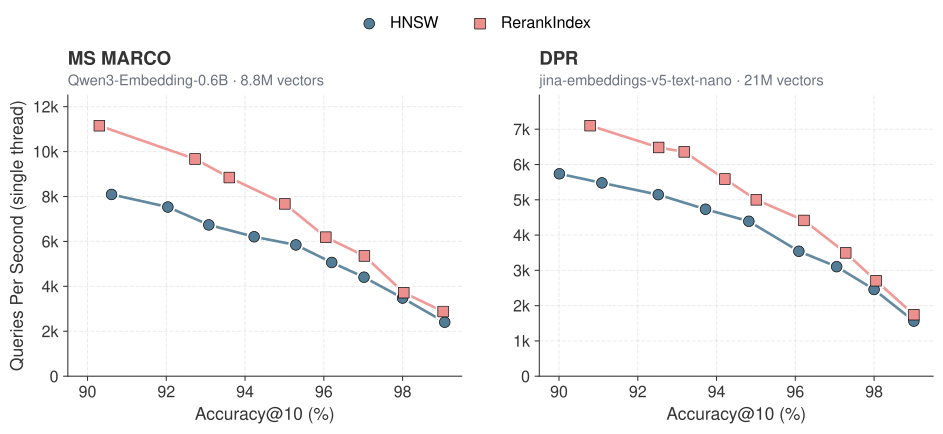
The dense HNSW stores the vectors in float16. The two-stage indexes search the graph
over 1-bit RaBitQ codes (MS MARCO) or 2-bit RaBitQ-ext codes (DPR) and rerank on
float16. They are 1.2–1.4× faster on MS MARCO and 1.1–1.25× faster on DPR, with the gap
narrowing towards 99% accuracy. They take 7–15% more memory, since they store the
compressed codes on top of the float16 vectors.
Sparse
The sparse collections are NQ14 from BEIR15, encoded with SPLADE CoCondenser16, and MS MARCO encoded with SPLADE-v317.
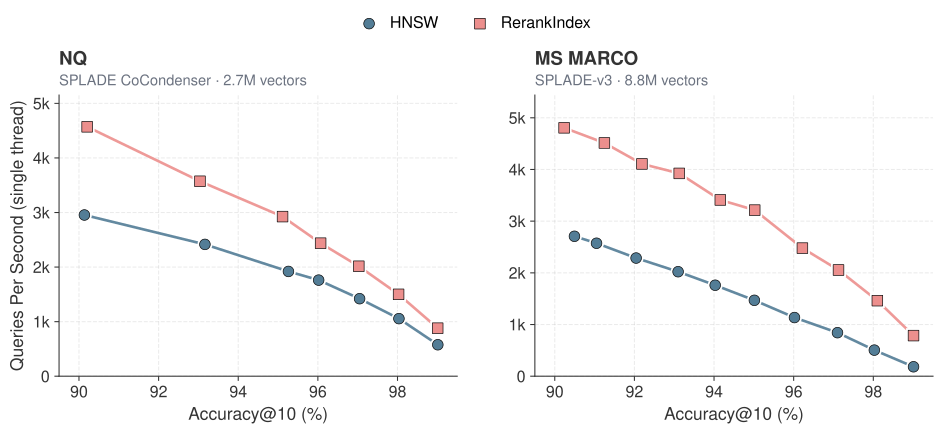
Here the first stage keeps 60% (MS MARCO) or 80% (NQ) of each vector's L1 mass. The two-stage index is about 1.5× faster on NQ, and on MS MARCO the gap grows from 1.8× at 90% accuracy to 4.3× at 99%. Memory stays about the same, because the two stages split the nonzero entries between them.
Part of the gain comes from the pruning itself: at 90% both MS MARCO indexes use the same graph parameters, and the first stage scores shorter vectors. The rest comes from build time. We set a fixed time budget for building our indexes, 1.5 hours on MS MARCO. A graph over the pruned vectors builds in less than half the time (2,265 s against 4,838 s with the same parameters). This leaves room in the budget for more construction effort, which the two-stage index uses to be faster at 95% and 99% accuracy. The same settings would take the plain HNSW build to 6,165 and 9,015 seconds, over budget.
What comes next
Since a RerankIndex is itself an index, its two stages can be any index and dataset. A few combinations the library already allows, which we have not
benchmarked yet:
- Dense-sparse hybrid pipelines. A sparse first stage rescored with dense embeddings, or a dense
first stage rescored with sparse ones, or maybe some rank fusion of the two (requires an extension of the
RerankIndex). - Cascades. A
RerankIndexas the first stage of anotherRerankIndex: 1-bit codes, then 4-bit codes, thenfloat16; or sparse retrieval, then a dense model, then multivector scoring.
If you try kANNolo on your data, tell us how it goes on GitHub.
References
-
Hervé Jégou, Matthijs Douze, Cordelia Schmid. Product Quantization for Nearest Neighbor Search. IEEE Transactions on Pattern Analysis and Machine Intelligence, 2011. doi:10.1109/TPAMI.2010.57 ↩ ↩2
-
Jianyang Gao, Cheng Long. RaBitQ: Quantizing High-Dimensional Vectors with a Theoretical Error Bound for Approximate Nearest Neighbor Search. SIGMOD, 2024. doi:10.1145/3654970 ↩ ↩2
-
Thibault Formal, Benjamin Piwowarski, Stéphane Clinchant. SPLADE: Sparse Lexical and Expansion Model for First Stage Ranking. SIGIR, 2021. doi:10.1145/3404835.3463098 ↩ ↩2
-
Omar Khattab, Matei Zaharia. ColBERT: Efficient and Effective Passage Search via Contextualized Late Interaction over BERT. SIGIR, 2020. doi:10.1145/3397271.3401075 ↩
-
Keshav Santhanam, Omar Khattab, Jon Saad-Falcon, Christopher Potts, Matei Zaharia. ColBERTv2: Effective and Efficient Retrieval via Lightweight Late Interaction. NAACL, 2022. doi:10.18653/v1/2022.naacl-main.272 ↩
-
Silvio Martinico, Franco Maria Nardini, Cosimo Rulli, Rossano Venturini. Multivector Reranking in the Era of Strong First-Stage Retrievers. ECIR, 2026. doi:10.1007/978-3-032-21324-2_4 ↩
-
Leonardo Delfino, Domenico Erriquez, Silvio Martinico, Franco Maria Nardini, Cosimo Rulli, Rossano Venturini. kANNolo: Sweet and Smooth Approximate k-Nearest Neighbors Search. ECIR, 2025. doi:10.1007/978-3-031-88717-8_29 ↩
-
Yu A. Malkov, D. A. Yashunin. Efficient and Robust Approximate Nearest Neighbor Search Using Hierarchical Navigable Small World Graphs. IEEE Transactions on Pattern Analysis and Machine Intelligence, 2020. doi:10.1109/TPAMI.2018.2889473 ↩
-
Jianyang Gao, Yutong Gou, Yuexuan Xu, Yongyi Yang, Cheng Long, Raymond Chi-Wing Wong. Practical and Asymptotically Optimal Quantization of High-Dimensional Vectors in Euclidean Space for Approximate Nearest Neighbor Search. SIGMOD, 2025. doi:10.1145/3725413 ↩
-
Tri Nguyen, Mir Rosenberg, Xia Song, Jianfeng Gao, Saurabh Tiwary, Rangan Majumder, Li Deng. MS MARCO: A Human Generated MAchine Reading COmprehension Dataset. CoCo Workshop at NeurIPS, 2016. ceur-ws.org ↩
-
Yanzhao Zhang, Mingxin Li, Dingkun Long, Xin Zhang, Huan Lin, Baosong Yang, Pengjun Xie, An Yang, Dayiheng Liu, Junyang Lin, Fei Huang, Jingren Zhou. Qwen3 Embedding: Advancing Text Embedding and Reranking Through Foundation Models. arXiv, 2025. arXiv:2506.05176 ↩
-
Vladimir Karpukhin, Barlas Oguz, Sewon Min, Patrick Lewis, Ledell Wu, Sergey Edunov, Danqi Chen, Wen-tau Yih. Dense Passage Retrieval for Open-Domain Question Answering. EMNLP, 2020. doi:10.18653/v1/2020.emnlp-main.550 ↩
-
Mohammad Kalim Akram, Saba Sturua, Nastia Havriushenko, Quentin Herreros, Michael Günther, Maximilian Werk, Han Xiao. jina-embeddings-v5-text: Task-Targeted Embedding Distillation. arXiv, 2026. arXiv:2602.15547 ↩
-
Tom Kwiatkowski, Jennimaria Palomaki, Olivia Redfield, et al. Natural Questions: A Benchmark for Question Answering Research. Transactions of the Association for Computational Linguistics, 2019. doi:10.1162/tacl_a_00276 ↩
-
Nandan Thakur, Nils Reimers, Andreas Rücklé, Abhishek Srivastava, Iryna Gurevych. BEIR: A Heterogeneous Benchmark for Zero-shot Evaluation of Information Retrieval Models. NeurIPS Datasets and Benchmarks Track, 2021. openreview.net ↩
-
Thibault Formal, Carlos Lassance, Benjamin Piwowarski, Stéphane Clinchant. From Distillation to Hard Negative Sampling: Making Sparse Neural IR Models More Effective. SIGIR, 2022. doi:10.1145/3477495.3531857 ↩
-
Carlos Lassance, Hervé Déjean, Thibault Formal, Stéphane Clinchant. SPLADE-v3: New baselines for SPLADE. arXiv, 2024. arXiv:2403.06789 ↩